In basic terms, between 1910 and 1930, a seismic shift took place in the image and composition of the suit, changes which reflected the different way in which clothing was perceived between the Edwardian period, and then the Jazz Age.
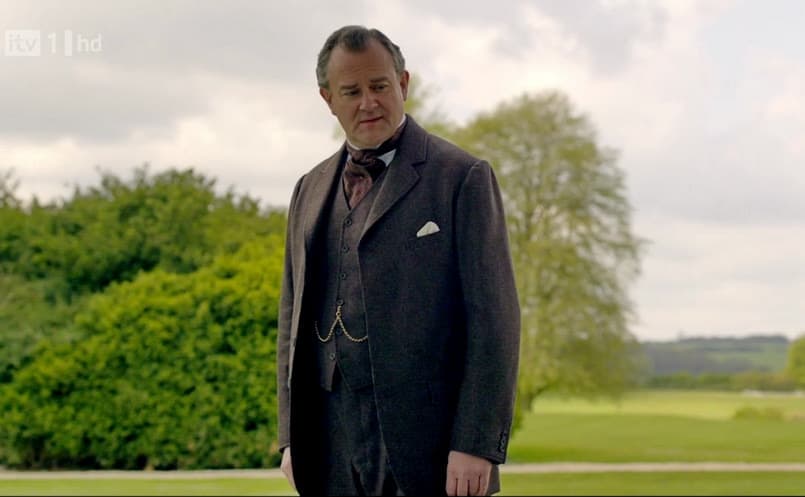
Hugh Bonneville in Downton Abbey Series One, illustrating perfectly, an authentic reproduction of a lounge suit circa 1910; note the high break of the waistcoat and high-cut four button jacket. The use of the cravat as opposed to neck tie is also still commonplace, as its voluminous shape helps to cover the exposed part of the undershirt. Compare this image with that of Robert Redford below.
Starting with the focal piece of the suit, perhaps the two most significant developments to the jacket were in changes to the lapel proportions during the 20s, followed by the introduction of a jacket vent to help the jacket sit better around the hips and buttocks in the 30s. The proportional balances between jacket skirt, waist and shoulder remained much the same as those lounge suits which had been common-place since 1900 (think the very stiff, high-cut, four button jackets and waistcoats of Downton Abbey for quick examples) but the number of buttons was reduced to either two or three buttons, with the button on the waist providing the focal point of the suit for the first time. This lengthened the shape of the lapel in the process, creating an altogether more elegant and modern sweeping shape to the jacket's chest. The shape of the lapel likewise became a lot broader, and the peaked-lapel, synonymous with statement Jazz Age gangster suiting, was popularised for the first time. The shape of the waist became more of a focus too, with sharply waisted, closely fitted jackets becoming de rigeur. Similarly, waistcoats became more of a statement piece, taking on a lower break, with the possible addition of lapels and a double-breasted shape for the ultimate sartorial statement.

Two interesting examples of late 1920s business suits. Note the elegantly shaped hourglass waists, and broad peaked lapels which also break lower, buttoning on the waist. Outward facing trouser pleats can also be seen flowing out from beneath the bottom of the waistcoats.
Trouser cuts also became significantly more flamboyant and diverse, thanks to the introduction of pleats. Prior to the 20s, all trousers were cut in a style that had seldom changed since the legendary Beau Brummell popularised trousers in the Victorian era; high-waisted (the trouser waistband straddling the belly button), with vertical cut welt pockets and a fitted shape. The 20s saw the introduction of both single inward and outward facing pleats (pleats which were set facing either into the centre of the trouser, or else falling away from it towards the hips). Come the 30s, single pleats were commonly replaced by a pair of pleats on each side of the trouser fly providing a fuller, more flowing look. On a high waist, the use of pleats (particularly inward-facing pleats) adds shape to the leg, they billow out from their placement points at the waistband over the hip and down the leg, producing an arced shape through the leg of the wearer, which goes into the waist or waistcoat, helping to draw the eye through the elegant hourglass shape created by the waists of the fitted coat and waistcoat.

A pair of bespoke trousers cut in inimitable Jazz Age style, high waisted, with a fitted leg finished with turn-ups, and twin inward facing pleats, curving into the waistband and flowing down through the leg.
All these aesthetic alterations were (as I said in my last post) a response to changing social attitudes to dress. The suit was no longer a purely functional item designed to cover the cotton undershirt, founded solely on the values of sobriety and social respectability. During the Jazz Age, clothes became more expressive, and acted increasingly as both status symbols and a creative means of self-expression. Pleats and turn-ups on trousers, a sharper waist, peaked lapels and larger lapel shapes, as well as altogether more jazzy double-breasted waistcoats were all stylistic innovations which were designed to enhance the image of the suit, regardless of the suit's functionality or respectability, purely for aesthetic reasons. It was these developments in the 20s and 30s which made Jazz Age suiting such a landmark era for tailored dress, and one of those aesthetics which has endured as fashionable today.

Robert Redford as Jay Gatsby in the 1974 Film adaptation. For the film, Ralph Lauren produced an exquisite range of historically accurate Jazz Age suits. The use of colour is more flamboyant, as are the full range of Jazz Age features; the broad lapels, two button jacket fastening, the mid-break double breasted waistcoat, the high waisted trousers with inverted pleats, and the fitted silhouette of the suit.
No comments:
Post a Comment